

News Center
Establishing a Factory: Yang Daihong: Understanding the Pharmaceutical Manufacturing Industry from a Grand Perspective
Release time:
2014-12-29
Establishing a Factory: Yang Daihong: Understanding the Pharmaceutical Manufacturing Industry from a Grand Perspective
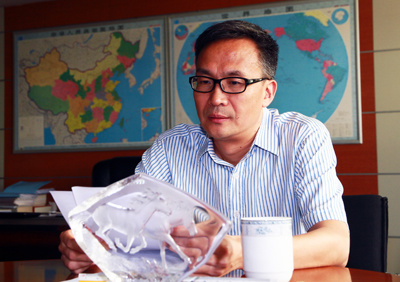
Yang Daihong graduated from Nanjing Pharmaceutical University (now China Pharmaceutical University) and is one of the first graduates in drug formulation in China. He served as the factory director of Lizhu Pharmaceutical Factory from 2000 to 2009 and is currently the executive director and vice president of Lizhu Group.
There is a contrast in the atmosphere of the on-site interview with Yang Daihong—every young manager who comes into contact with the new Lizhu factory talks about it with passion and commitment, viewing it as a rare and valuable experience in their life journey. However, when discussing the new factory, Yang Daihong appears surprisingly calm, almost as if it is a normal state.
As the topic unfolds, we gradually understand that this sense of normalcy comes from his decades of reflection and practice in drug manufacturing. The executives of Lizhu Group learned to measure the pharmaceutical industry with a grand vision during the early implementation of GMP in China's pharmaceutical industry and made comprehensive plans for Lizhu Pharmaceutical Factory. He believes that a pharmaceutical factory cannot be confined to its own industry; the knowledge gained behind closed doors is extremely limited, and it is necessary to go out and learn from various industries.
Without long-term planning, it is indeed difficult to lead and manage such an excellent team and such an outstanding factory.
Discussing the construction of the new factory
1. Design is the top priority. Whether it is the formulation of the product itself or the process flow.
2. The process is very important. The construction process goes from the inside out, from formulation and process to equipment selection, then to workshop layout, and finally to park building planning.
3. Hardware should be met as much as possible. Large-scale industrial operations cannot rely solely on human awareness and standardized operations. The equipment in our hormone freeze-drying workshop, the production line in the solid dosage workshop, and the fully automated warehouse Swisslog system all embody this concept.
4. Focus on talent cultivation. From design to construction, users are involved, which is beneficial for talent growth. One cannot build a group of people and use another group. This construction process requires people, and the personnel themselves learn knowledge and skills while taking on responsibilities, and at the same time, learn new things through discussions and adjustments with various parties (design companies, suppliers, etc.), achieving a relatively comprehensive improvement. The management team of the new factory consists mostly of young people who matured during the construction process.
Discussing design and concepts
I am quite satisfied with some design concepts in the construction of the new factory. The hormone freeze-drying workshop introduces automatic in-and-out boxes, which is a trend; the solid dosage workshop has a three-dimensional layout, which is already quite mature internationally and represents advanced technology. The fully automated warehouse uses Swisslog equipment, a fully automated system. This is a system that reflects industrial civilization.
The concept of the central corridor in the new factory is also quite advanced. In simple terms, it is a central logistics passage connecting the central storage warehouse and various production workshops, with a layout centered around the logistics chain, saving space for logistics in and out and shortening transportation routes, making it easy to achieve automated control.
The establishment of the central corridor also went through a process. We bought the land in 2004, conducted domestic research in 2005, and in 2006, we found the Fourth Nuclear Institute for design—at that time, I proposed the concept of the central corridor. In 2007-2008, we found the Australian company S2F—this was our first contact with a foreign design company, and domestic companies like Wyeth and Schering-Plough also worked with this company. In 2008, through design bidding, we confirmed the German company IPI and established the concept of the central corridor. After that, we went to Europe for inspection, which solidified this concept.
Discussing personnel and talent
Lizhu Group does not have a concept of seniority in hiring; we have no constraints in selecting talent and boldly employ newcomers. Whoever can do the job, has a clear mind, is willing to learn, and has an innovative spirit will be hired. Young people just lack some experience, which can be quickly accumulated and gained through practice.
Lizhu has a special phenomenon: the quality responsible persons at Lizhu can all become factory directors, including myself, Wang Rui, and Xie Haiyan from Limin. The system in this regard at Lizhu is quite good; our production factory only manages quality and delivery, which is conducive to establishing a quality-first culture. While there is inevitable pressure on costs, everyone feels some pressure, but it is also about emphasizing savings under the premise of ensuring quality; ultimately, quality remains the top priority.
Our cadres are required to rotate positions, and we have been doing this. We require the equipment department manager to be able to serve as the manufacturing department manager, and the manufacturing department manager can manage equipment. Production and quality should be interchangeable.
The construction of the new factory has matured a group of talents, but many have also left. Regarding the retention of talent, I believe personal choices should be respected; it is not a bad thing for young people to change jobs a few times. Of course, for those engaged in technology and production, they need to be able to calm down, reset frequently, maintain a good mindset, and achieve even better results.
Discussing GMP and pressure
Since 2004, we have basically clarified and controlled all regulatory risks related to GMP. My view is that if you truly operate according to regulations, it will not put pressure on operational employees. Only when they are under no pressure can the true intentions of the upper management reach the grassroots employees. Our employees work easily; they know that the leadership is genuinely doing things, and the boss truly values quality, prioritizing quality, so the employees' mindset and actions become very clear and straightforward, ensuring quality in a serious and scientific manner.
It cannot be ruled out that there are still some factories doing GMP, presenting one set of practices in front and another behind, which will never lead to good GMP. In fact, this is not just a simple GMP concept; it is a matter of quality and civilization.
Discussing modern industrial civilization
"Pharmaceuticals seem miraculous because they are related to human life, but in fact, their modern industrial core is not high."
It is not feasible for the pharmaceutical industry to work behind closed doors. Our generation has no old resources to rely on; we do not have much good experience in pharmaceutical industry and drug manufacturing.
When our generation was in college, the concept of pharmaceuticals was simply to be able to produce drugs. The true modern industrial concepts and practices were brought in by some foreign companies like Janssen, which we need to comprehend, understanding not only the phenomena but also the reasons behind them. The pharmaceutical industry needs to broaden its horizons and frequently learn and think from other advanced industries, such as the automotive and electronics manufacturing industries, bringing back universal advanced industrial civilization.
Therefore, in 2001, I proposed that the operation of pharmaceutical factories needs to identify several broad coordinate points:
From the perspective of dosage forms, sterile preparations should learn from China Resources, non-sterile (solid preparations) should learn from Xi'an Janssen; cost control should learn from Handan Steel; pollution control and environmental protection should learn from the electronic chip industry; automation and software control as well as traceability should learn from software companies; new factory design should consult the Fourth Nuclear Institute and Chengdu's 101 Factory—they used to design for the electronics manufacturing industry; drug logistics and storage should learn from the bank's safe system; packaging materials should learn from automated cigarette factories.
For example, starting from 2002, we began to implement visual management and 5S (at that time, the concept of status identification was the only one in GMP), learning how to manage materials and products—however, the automotive and television industries had already been doing this for a long time. At that time, we organized management to visit automotive and television factories for learning.
Incorporating insights from other industries, one must have a historical perspective and a developmental vision to learn and be inclusive, in order to gain successful insights.
Related Information